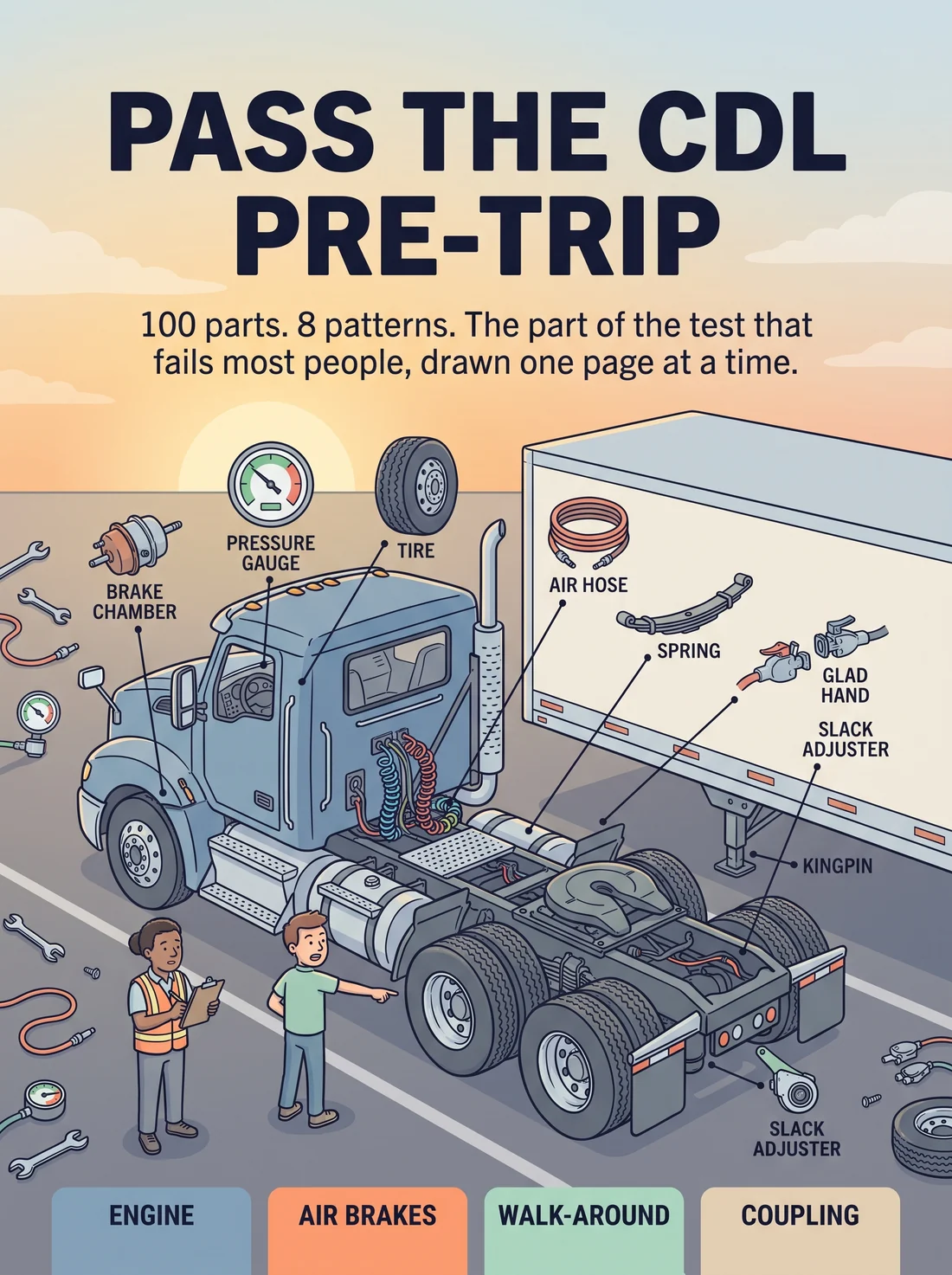
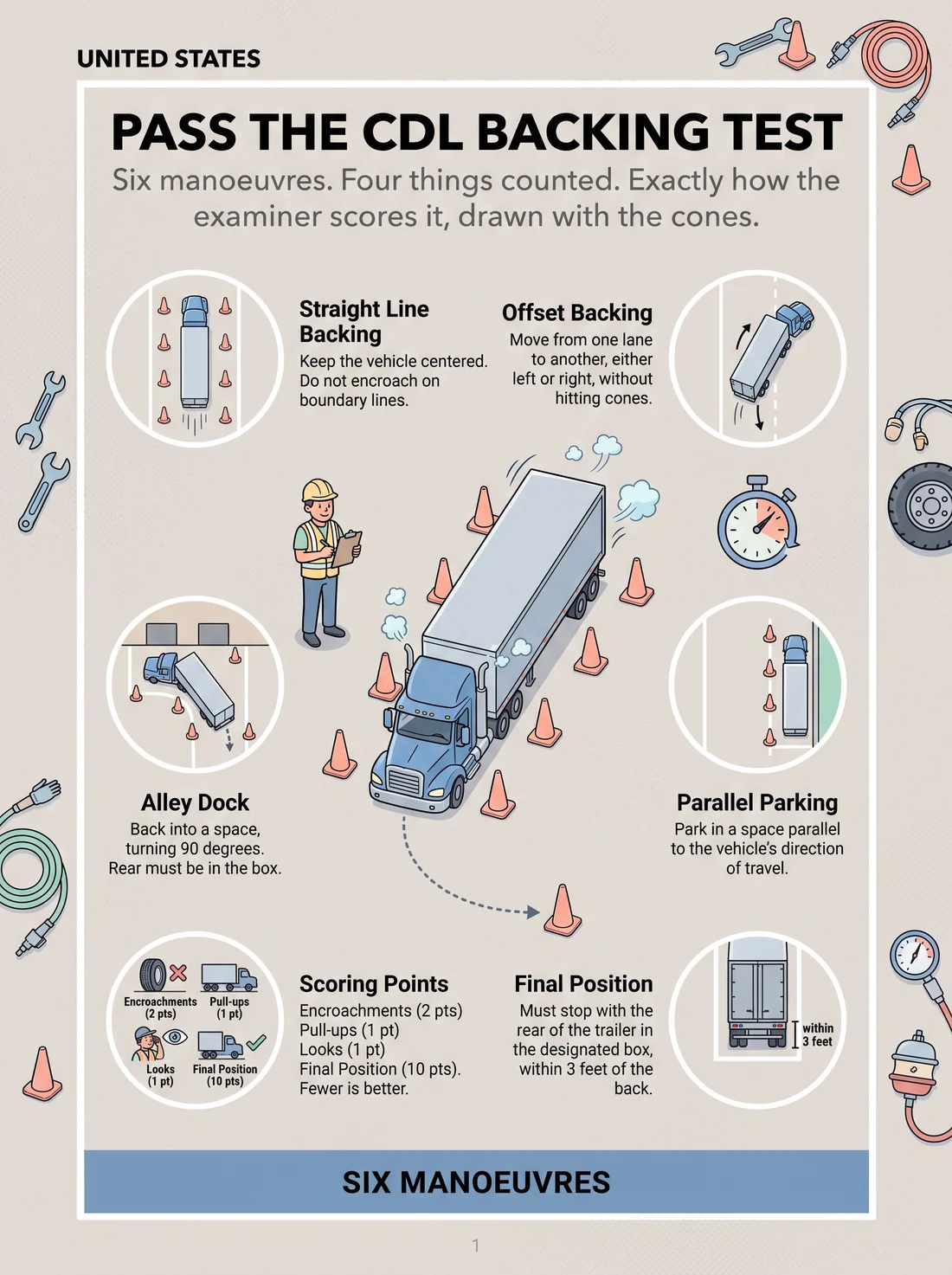
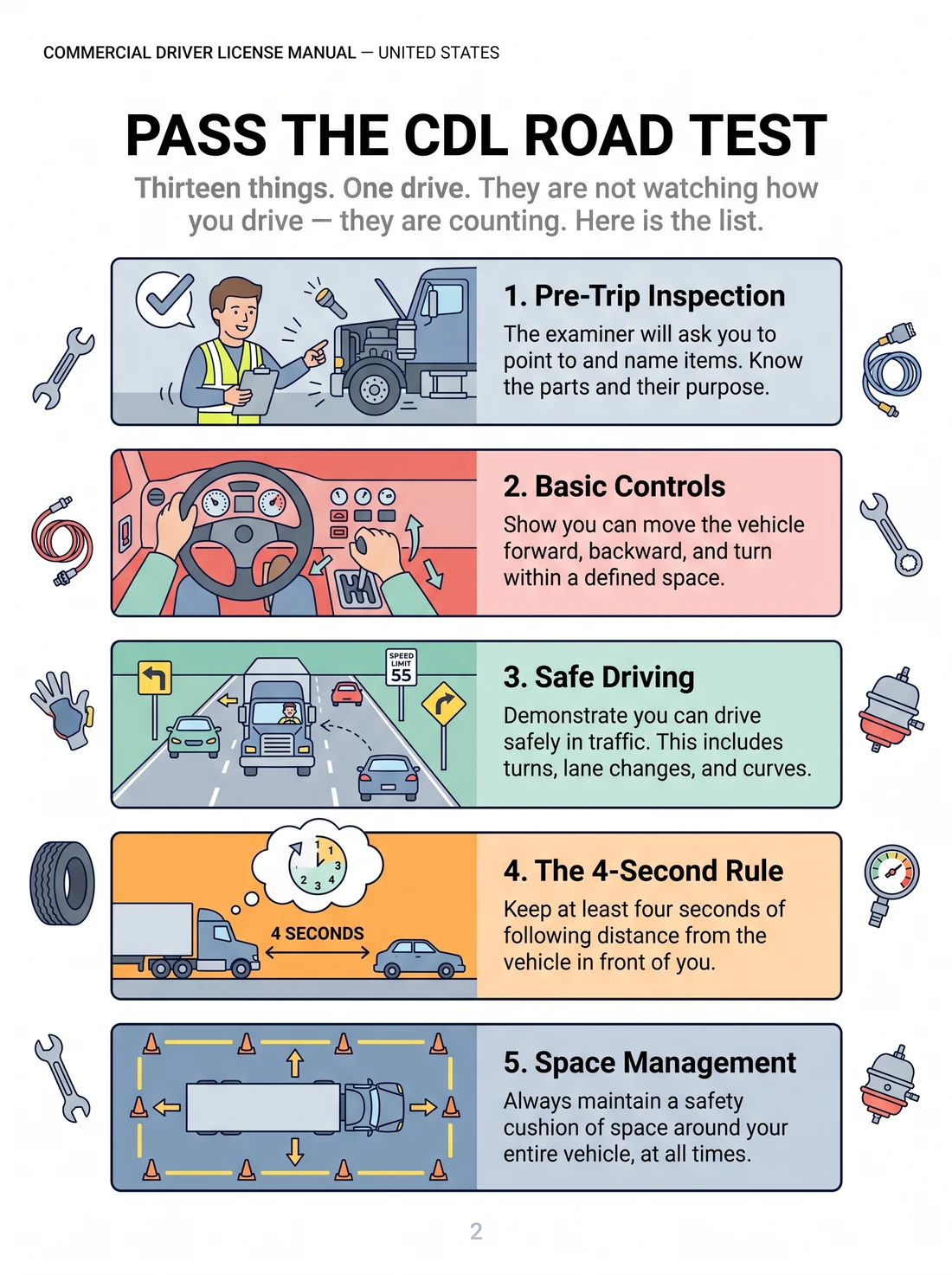
It looks like a hundred items. It is really eight patterns that repeat. 100 illustrated pages for the part of the skills test that fails most people — plus the other two parts, free.
Not a checklist you have already seen. Tap any page to read it full size.
You have been handed a list of a hundred parts and told to learn it. That is why it feels impossible — and why people who studied for three weeks still blank out in front of the examiner.
Here is the thing nobody tells you: almost every part is checked the same way. Eighteen wheels, one pattern. Every hose, one pattern. Every bracket, one pattern. And about every single part you say the same two things: what condition it is in, and whether it is held on properly.
Learn eight patterns and the hundred parts stop being a list. They become things you recognise.
You are not trying to remember.
You are trying to see.
The book is the first one — the one that fails most people. The other two come with it, free.
100 pages. Engine, cab, air brakes, the walk-around, coupling and trailer, plus six sheets made to print and take to the yard.
The six official manoeuvres drawn with their cones — and how the examiner actually scores them. Stopping is free. Pulling forward is not.
They are not watching how you drive. They are counting thirteen specific things, each one scored every time it comes up. One page each.
The formula you say about every part, the four words that cover most of the test, and the route you never have to think about again.
Under the hood and behind the wheel, in the order the official method walks it. Fluids, belts, steering, gauges and the emergency kit.
The only part that fails you on the spot. The seven steps drawn one by one, and every number the test asks for.
Zone by zone around the tractor. Wheels, suspension, brakes, fuel and the steering you have to grab, not look at.
The part nobody draws because it is underneath. The kingpin, the jaws and the gap that means it is not coupled.
Made to print and take to the yard: the route, the formula, the seven brake steps, every number on one sheet, the wheel check, and a blank page to test yourself.
You do not have to do it this way. But if you have a date on the calendar and no plan, start here.
Part I. Two things about every part, four words, one route. After this the hundred items stop being a list.
Engine, cab and the walk-around. A few pages a day is enough; you are recognising shapes, not memorising names.
The seven steps in order, out loud, until you can do them without the book. This is the part that fails people on the spot.
The kingpin, the jaws, the gap. The part that is underneath and that nobody ever draws for you.
Print the six tear-out sheets, stand next to a truck and run the whole thing from the blank page. If you can do that, you can do it for the examiner.
Three weeks, a date on the calendar and four to seven thousand dollars already spent. You do not have time to learn a hundred items the slow way.
You know the parts. What went wrong is that you blanked, skipped a zone or missed a step of the brake check. This book is the route and the words.
Every part is drawn next to its name, so you learn the word and the thing at the same time instead of translating a list.
Not a blog, not a practice app: the official manuals the test is written from. Each figure was looked up, one by one, before the page was drawn.
That is not a slogan — it changed the book. The low air pressure warning, for example, does not say the same thing everywhere: most manuals say the signal must come on before pressure falls below 55 psi, New York says below 60, and California words it as a band from 55 to 75. A book that prints one of those as the answer is wrong in most of the country.
So that page does not print a number. It shows you that it varies, and leaves you a space to write your own state's.
Your examiner's score sheet always wins.
The book says so on page three.
All three PDFs arrive by email within minutes. One payment, no subscription.
For 30 days. If a file does not open, if what you received is not what this page describes, if you were charged twice or the download never arrived, write to us and we refund you in full.
One email to info@medicalstudylab.com is enough.
Neither. This is the vehicle inspection — the pre-trip — which is the first of the three parts of the skills test, and the one most people fail. The two bonus books cover the other two parts.
Yes, and it is built for that. Every figure was checked against the official handbooks of five states. Where they all agree, the number is printed. Where they do not — the low air warning is the clearest case — the page shows you that it varies and leaves you a space to write your own state's number. Your examiner's score sheet always wins, and the book says so on page three.
Yes. This is not a course and it does not give you a licence or a certificate. It is the illustrated material that goes with the training you are already paying for.
By email, straight after you buy. Three PDFs you can read on your phone in the yard or print and take with you.
Yes, as many times as you want, for yourself. The last six pages are made to be printed.
It is written for the Class A combination vehicle, because that is the longest inspection and the one with the coupling and the trailer. If you are testing in a straight truck, the engine, cab, brake and walk-around parts are the same; the coupling and trailer part will not apply to you.
The pre-trip is the part of the skills test that fails the most people.
Not because it is hard. Because they were handed a list instead of a picture.
A hundred parts.
Eight patterns.